
Most homes in Central California can fit between 15 and 35 solar panels, depending on roof size, orientation, and obstructions. However, the number of panels you actually need is based on your electricity usage and typically ranges from 10 to 25 panels for the average household.
When Central California homeowners start thinking about solar, one of the first questions they ask is simple: how many solar panels can I actually put on my house?
The answer comes down to two things that are often confused. How many panels you need depends on your electricity usage. How many panels you can install depends on your roof. Both matter equally. The right system is where those two numbers meet.
Here is a clear, practical guide to help you estimate both, based on real Central Valley conditions.
How Many Solar Panels Do You Need? Start With Your Electricity Bill
The most common mistake homeowners make is sizing a solar system based on square footage alone. While size gives a rough idea, it is not the main factor. Two homes with the same square footage can have very different energy usage depending on occupancy, air conditioning, pools, and whether appliances are electric or gas.
The right starting point is your electricity bill.
Step 1: Find your annual kWh usage
Add up your total kilowatt-hour (kWh) usage from the past 12 months. If you do not have that data, your utility can usually provide it.
For context, the average California home uses about 6,500 to 7,500 kWh per year. In the Central Valley, higher air conditioning demand often pushes that closer to 10,000 to 15,000 kWh or more.
Step 2: Account for your local sun hours
Central California gets about 5 to 5.5 peak sun hours per day, which makes it one of the most productive regions for solar. Because of this, fewer panels are needed compared to cloudier areas.
Installers account for this using a production ratio. In this region, a typical range is 1.5 to 1.7, meaning each kilowatt of solar produces about 1,500 to 1,700 kWh per year.
Step 3: Run the numbers
Solar sizing is based on two simple formulas:
- System size (kW) = Annual kWh usage ÷ production ratio
- Number of panels = System size (watts) ÷ panel wattage
Modern panels typically produce 380 to 450 watts. Using 400W panels as a baseline, here is how common Central Valley usage levels translate into panel counts:
| Annual kWh Usage | System Size Needed | Approximate Panel Count (400W panels) |
| 6,500 kWh | 4.0 to 4.3 kW | 10 to 11 panels |
| 9,000 kWh | 5.3 to 6.0 kW | 14 to 15 panels |
| 12,000 kWh | 7.0 to 8.0 kW | 18 to 20 panels |
| 15,000 kWh | 8.8 to 10.0 kW | 22 to 25 panels |
These are working estimates, not exact figures. Your actual system size will depend on your specific usage patterns, your roof’s orientation, and the equipment your installer recommends.
How Many Solar Panels Can You Fit on Your Roof?
This is the other half of the equation. Even if your energy usage calls for a certain number of panels, your roof still has to physically accommodate them.
Several factors affect how many panels your roof can support:
Usable roof space
A typical roof may be 1,500 to 2,000 square feet, but not all of it is suitable for solar. Installers prioritize south- and west-facing sections, which produce the most energy. North-facing areas are usually avoided.
Setback requirements
Building codes require clear pathways for fire safety. In California, this often means leaving about 36 inches along roof edges and ridges, reducing usable space by roughly 20 to 25 percent.
Roof obstructions
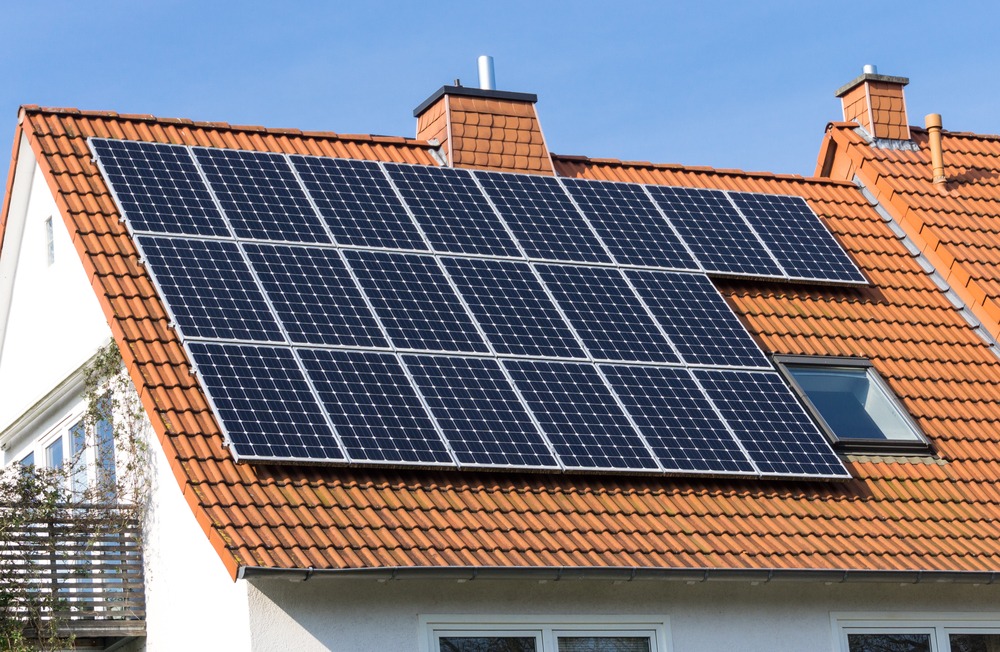
Chimneys, vents, skylights, and HVAC equipment all take up space and limit panel placement.
Roof angle and pitch
Moderately pitched roofs work best. Very flat or steep roofs may require special mounting and can limit layout options.
A simple estimate you can use
Most solar panels take up about 17 to 20 square feet. To estimate capacity:
Multiply your usable south- or west-facing roof area by 0.75, then divide by 17.5.
For example, 800 square feet becomes about 600 usable square feet, which fits roughly 34 panels. In reality, obstructions and layout constraints will usually reduce that number.
If space is limited, higher-efficiency panels can produce more power in a smaller footprint, helping you meet your energy needs with fewer panels.
Is There a Limit on How Many Panels You Can Install?
Yes, and it is usually set by your utility.
In California, most utilities allow solar systems sized to produce up to 120% of your annual electricity usage. For example, if you use 10,000 kWh per year, your system can typically be designed to produce up to 12,000 kWh.
This prevents oversizing systems just to generate excess energy. Lower usage means a smaller allowed system, while higher usage, common in Central Valley homes, allows for more flexibility.
The interconnection process ensures your system is approved and connected to the grid. Pacific Solar manages this step entirely in-house, from application to Permission to Operate.
How Many Solar Panels Does a 2,000 Square Foot Home Need?
A 2,000-square-foot home in the Central Valley typically uses 9,000 to 12,000 kWh per year, depending on occupancy, appliance efficiency, and air conditioning use.
With Central California’s strong solar production (around a 1.6 ratio), most homes this size will need 14 to 20 panels to offset most of their electricity usage using standard 400W panels. Higher-efficiency panels can reduce that number, while higher energy use or additions like an EV charger may increase it.
A custom site assessment is the only way to determine the exact number for your home.
What Is the 20% Rule for Solar Panels?
The “20% rule” is a general guideline that most residential solar systems use 20% or less of a home’s total roof area.
For example, a typical 7 to 8 kW system in Central California requires about 300 to 380 square feet of space. On a roof that is 1,700 to 2,000 square feet, that is well under 20% of the total area.
This rule is helpful as a quick check. If your roof seems large, it likely has enough space for solar. In most cases, roof size is not the limiting factor.
What matters more is usable space, including:
- Roof orientation (south- and west-facing sections produce the most energy)
- Shading from trees or nearby structures
- Obstructions like vents, chimneys, and skylights
For most Central Valley homes, energy usage and sun exposure have a bigger impact on system size than total roof area.
Can a House Run 100% on Solar?
Yes. Many Central California homeowners already power their homes entirely with solar, and it is a realistic goal for most well-suited properties.
To do this, your system must be sized to match your full annual electricity usage. Battery storage is also important if you want energy independence at night. Without it, grid-tied systems still rely on utility power after sunset, though daytime production offsets much of your usage over time.
Under California’s current NEM 3.0 structure, adding battery storage also improves savings by storing excess energy during the day and using it during higher-cost evening hours.
Pacific Solar designs each system around your goals, whether that is reducing your bill or achieving full energy independence with battery backup.
Why Getting the Number Right Matters
Undersizing your system means ongoing electric bills and missed savings. Oversizing means paying more upfront than necessary. Getting the number right is key to a solar investment that performs properly for decades.
That is why Pacific Solar reviews a full 12 months of your usage, along with your roof layout and energy goals, including plans for EVs or battery storage. Every system is custom-designed for maximum efficiency in your home.
All installations are completed by our in-house team and backed by a 25-year workmanship and savings guarantee. If your system does not deliver as promised, we will make it right.
With over 40 years of experience in the Central Valley, we know how to get the sizing right the first time.
Ready to Find Out How Many Panels Your Home Needs?
The most accurate answer to “how many solar panels can I have on my house?” is not one that comes from a formula. It comes from a real assessment of your roof, your utility bills, and your goals by someone who knows the Central Valley and has done this work for over four decades.
Call us at (559) 251-5592 or request a free consultation online. We will review your usage, evaluate your roof, and give you a custom system recommendation with no pressure and no obligation.
Frequently Asked Questions
How many solar panels do I need for a 2,000 sq ft home?
Most 2,000-square-foot homes in Central California need between 14 and 20 panels, depending on energy usage and air conditioning demand.
How many solar panels do I need for my house overall?
Most households need between 10 and 25 panels, but the exact number depends on your annual electricity usage, sun exposure, and panel efficiency.
How many solar panels can I fit on my roof?
Most homes can fit 15 to 35 panels, depending on usable roof space, orientation, and obstructions like vents or chimneys.
Can a house run 100% on solar panels?
Yes. A properly sized system can offset 100% of your electricity usage. Adding battery storage allows you to use solar energy at night and during peak rate hours.
What limits how many solar panels I can install?
The main limits are usable roof space, orientation, shading, and local utility rules. Most utilities allow systems sized up to about 120% of your annual usage.
Why is my electric bill still high with solar panels?
This can happen if your system is undersized, your energy usage increased, or you are using more electricity during peak rate hours without battery storage.
What is the 20% rule for solar panels?
It is a general guideline that solar systems typically use less than 20% of a home’s total roof area. Most roofs have more than enough space for solar.